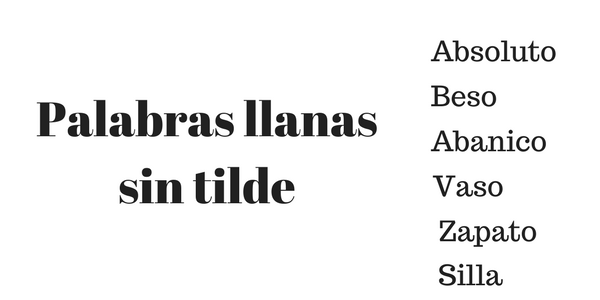
The Spanish language is rich in words that take the tilde to indicate the stressed syllable. However, there are also simple words that cannot be understood, as their accent falls on the penultimate syllable naturally. In this sense, it is important to know these words to be able to write them correctly. In this text, we will present a list of 100 simple words in Spanish, some with tilde and others without tilde, to help you improve your spelling and language comprehension. Keep reading to discover these words and practice your writing!
When do Spanish words have an accent?
In Spanish, words carry an orthographic accent in certain situations. The accent, also known as a tilde, is used to indicate the stressed syllable of a word, to differentiate homographs, or to comply with accentuation rules.
Monosyllabic words generally don't have an accent mark unless there's a need to differentiate them from another word with the same sound, like "si" (if) and "sí" (yes). Acute words have an accent mark when they end in a vowel, "n," or "s," and are accented if the accent mark is placed at the end of the word, like "jamón."
Grave words are accented when they end in a consonant other than "n," "s," or a vowel, and are accented if they do not end in a vowel, "n," or "s," such as "fácil." The words esdrújulas and sobresdrújulas always have an orthographic accent, regardless of the previous rules.
It's important to be aware of Spanish accentuation rules to write correctly and avoid spelling mistakes. Practicing accentuation is essential to improving your language proficiency and communicating effectively.
Meaning of the words llanas in the Spanish language: understand the correct accentuation and pronunciation.
The plain words in the Spanish language are those that take the stressed syllable into the penultimate syllable. It is important to understand the correct accentuation and pronunciation of these words to communicate effectively in Spanish.
In Spanish, the llanas words llevan tilde when they end in a consonant that is not -n, -s, the vocal. For example, the word “cántaro” takes tilde in the first “a” because it is a plain word that ends in a consonant that is not -n, -s, the vocal.
To correctly pronounce the common words in Spanish, it is important to pay attention to the stressed syllable and emphasize it when speaking. For example, in the word “telephone”, the stressed syllable is “lé” and must be pronounced with greater intensity.
It is essential to know the correct accent and pronunciation of common words in Spanish to avoid mistakes when speaking and writing in this language. Practicing your pronunciation and paying attention to the tilde in familiar words will help you improve your fluidity and precision in Spanish.
Identifying the stressed syllable in the Spanish language: practical tips for correct pronunciation.
One of the most important characteristics of the Spanish language is the accentuation of words, which can influence the correct pronunciation of them. Identifying the stressed syllable is fundamental to being able to speak the language properly.
In Spanish, the tonic syllable is the one in which the prosodic accent falls, and that is the syllable that is pronounced with greater intensity. To help you identify the stressed syllable, here we present some practical tips:
1. Words without tilde: in Spanish, the acute words are tilde when they end in vocal, “n” or “s”. For example, the word “watch” is tilde in “o” because it is sharp. However, the word “dog” doesn't take tilde because it's not sharp. Identifying whether a word is acute will help you determine the stressed syllable.
2. Words with tilde: the esdrújulas and supersdrújulas words are always llevan tilde. For example, the word “music” is esdrújula and the stressed syllable is the third-to-last. However, the word “quickly” is supersedrújula and the stressed syllable is the one before the antepenultimate one.
3. General rules: if a word is not acute, esdrújula or oversdrújula, the stressed syllable is found in the penultimate syllable. For example, in the word “orderer”, the stressed syllable is “de”. In the word “telephone”, the stressed syllable is “lé”.
Identifying the stressed syllable in words is essential to pronounce it correctly in Spanish. Practicing with simple words without tilde and tilde will help you improve your pronunciation and fluidity in the language. Keep practicing and you will see results!
100 Simple Words Without Tilde and With Tilde (in Spanish)
More than 100 simple words, with and without tildes, such as porta-bandeira (flag bearer), leque (fan), abortivo (abortive), adorno (adornment), travesseiro (pillow), abelha (bee), abrigo (shelter), atento (attentive), or absoluto (absolute).
Simple or serious words are those whose pronunciation stress is on the penultimate syllable. Simple words can be found with or without a tilde.
Simple words without a tilde are all words that end in "n," "s," or a vowel. Serious or simple words with an accent are those that end in a consonant, except for "s" or "n."
Simple words without tilde
Flag bearer
Signaling
Cancelled
Ventilador
Crowded
Grocery store
Supply
Abelha
Abortive
Abrasive
Casaco
Absolute
Grandfather
Grandfather
Transport
Conditioning
Watercolor
Aquarium
Accused
bye
Administrative
Ornament
Ornament
customs
Adult
Adults
Water
Water
Ar
Sewage
Carpet
Shop
Pillow
Yellow
Amazon
Analyze
Stunned
Before
Cancel
Sand
Argentina
Recife
Takes on
Attentive
Aircraft
Wasp
Balance
Banana
Banco
Flock
Bandit
Banker
Casa de Banho
Kisses
Boat
Snack
Barco
Barco
Good
Scarf
Search
Horse
Hair
Cable
Supports
Hip
Shoes
Bed
Cabin
Walk
Shirts
Shirts
T-shirt
Sweet potato
Countryside
Countryside
Music
Capricorn
Face
School
Carmen
Pasta
Eyebrows
Chango
Casaco
Bell pepper
Corn
Heaven
Prego
Sewage
Kitchen
cook
Quilt
Fang
Colombia
Ferret
Eat
Buy
Computers
Conjure
Spell
Build
Consume
Consume
Hearts
Execute
Correct
I enjoy
Curtains
Notebook
Painting
As
Spoon
Faca
Neck
Account Log In
Tales
Declarations
mess up
To destroy
Tooth
Disc
Diversões
Sunday
Mourning
Elephant
Company
Plug
Angry
Salad
Scorpio
He writes
Waiting
Stadium
Estimate
Stars
Organization
Study
Great
Eugenia
Eugenia
figure
Skinny
folio
Fruit
Pig iron
Galaxies
Gado
Gas
Cat
Genius
Fat man
Guitar
Worm
Ants
Image
Sagacity
Try
Gardens
Giraffe
Young man
reproduce
Thursday
Juices
Brick
Leite
Book
Books
Cleaning
it rains
Rain
Mole
Monday
Professor
More than
Sends
Butter
Apple
Mariano
Tuesday
Hammer
Mate
Half
To memorize
Quadro
They lie
Backpack
Sample
MOVER
Clouds
Cloudy
Block up
Eyes
Waves
Belly button
order
Organize
Urso
Panther
To
Speaker
Freckles
Fish
Chest
Hair
Wait
Perfume
Dog
Eyelashes
Stone
Leg
Painting
Fish
Iron
Planet
to plan
Beach
Penalty
Few
Puts
Bean
Problem
Port (The Harbour District)
About Us
Receive
Write
Régua
T-shirt
Summary
Check
Rhino
Rock
Break
Clothes
Rosary
Salutation
Holy
Serious
Signs
Cadeira
Soup
Surprised
Good luck
Overlays
Arises
Tamarind
Covered
Key
Keyboard
Chaves
Temperature
thermos
Nipple
EARTH
Record player
Tom
Fool
Trap
rag
Universe
Cow
Glass
Sell
Come
Vicuna
Friday
Volume
Flight
Airline tickets
Flip flops
Slippers
Shoes
Simple words with tilde
Abstracted
Accentuate
Aphonia
Agony
Album
piggy bank
Alcazar
Liahona
Arrogance
Amber
Angel
Tree
Archaism
Aspen
Car
Sugar
Baez
Barahunda
Benitez
Bermudez
Biceps
Bistrado
Bolivar
Cadiz
Cup
Cancer
Character
Jail
Poster
Catheter
Zenith
Caesar
Grass
Paper
Climax
Codeine
Condor
Consul
cut
Crater
Cream
Christopher
Christopher
Cuauhtemo
Date
Weak
deteriorated
Deism
give me
Days
Diaz
Díez (When it comes to the surname)
Hard
Distracted
Docile
Dollar
Ductile
Duo
Selfish
Elijah
Rubber
Enriquez
Sterile
I would study
Ether
Easy
Feism
Femur
Fertile
Fluorine
formaldehyde
Brittle
Beans (word that is emphasized in some Latin American countries such as Colombia)
Football
Gonzalez
Skilled
Hector
henriquez
Jimenez
I would play
Pencil
You read
Leism
Leader
Lopez
Of marble
Martinez
Martyr
Master
Phone
Nectar
Ñandúes
Oscar
Perez
Pony
Poker
proceed
Fugitive
Roots
Ramirez
Relapse
All time lap record
Stir
Rimac
Rivers
Rodriguez
Watermelon
Earthquake
Simile
Suarez
Touch
Tandem
Tangier
Trailer
Clover
triceps
Tunnel

Contents
- 1 When do Spanish words have an accent?
- 2 Meaning of the words llanas in the Spanish language: understand the correct accentuation and pronunciation.
- 3 Identifying the stressed syllable in the Spanish language: practical tips for correct pronunciation.
- 4 100 Simple Words Without Tilde and With Tilde (in Spanish)
- 5 Simple words without tilde
- 6 Simple words with tilde