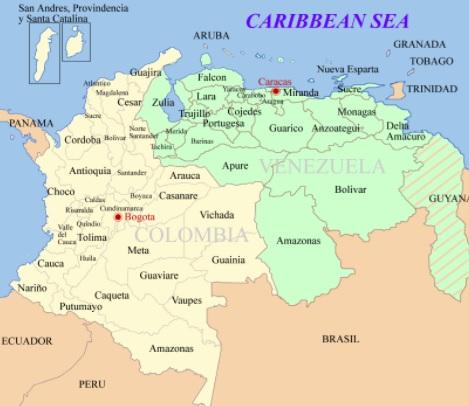
Venezuela's geographic position exerts significant influence on the country, bringing with it a series of consequences that shape its history, economy, and international relations. Located in South America, Venezuela stands out for its strategic location, which grants it privileged access to important trade routes and natural resources. However, this position also poses challenges, such as dependence on commodities and political instability resulting from external interests. In this context, it is possible to identify seven consequences of Venezuela's geographic position that directly impact its development and insertion in the international arena.
Impacts of the economic crisis in Venezuela: what were the consequences for the country?
Venezuela is currently facing an unprecedented economic crisis that has had devastating impacts on various sectors of the country. The situation has been exacerbated by a number of factors, including falling oil prices, economic mismanagement, and widespread corruption. As a result, the Venezuelan population has suffered from runaway inflation, food and medicine shortages, and a deterioration in public services.
One of the most serious consequences of the economic crisis in Venezuela was the increase in poverty and social inequality. Millions of Venezuelans were pushed below the poverty line, unable to meet their basic needs. Furthermore, the crisis also led to a mass exodus of Venezuelan citizens, who sought better living conditions in other countries in the region.
The economic instability has also had political repercussions, with protests and internal conflicts intensifying. The Venezuelan government has faced criticism for its handling of the crisis and the repression of political opponents. The lack of effective solutions to the economic crisis has created a climate of uncertainty and instability in the country.
Another significant consequence of the economic crisis in Venezuela has been the impact on access to basic services, such as healthcare and education. Hospitals lack resources to serve the population, schools struggle to function properly, and Venezuelans' quality of life has been severely affected.
In short, the economic crisis in Venezuela has had disastrous consequences for the country, affecting the lives of millions of people and generating political and social instability. Economic recovery and overcoming the challenges Venezuela faces will require coordinated efforts and effective measures from the authorities and society as a whole.
The main factors that led to Venezuela's economic collapse.
Venezuela is facing an unprecedented economic crisis, and several factors have contributed to this disastrous situation. Among the main reasons are falling oil prices, the government's economic mismanagement, widespread corruption, and a lack of economic diversification.
Venezuela is a country heavily dependent on oil exports, and the drop in international oil prices has had a devastating impact on the Venezuelan economy. With reduced oil revenues, the Venezuelan government struggled to maintain social programs and investments necessary for the country's development.
Furthermore, the Venezuelan government's economic mismanagement contributed to the crisis. Misguided economic policies, such as the uncontrolled printing of money to finance public spending, led to hyperinflation and the devaluation of the Venezuelan currency.
Widespread corruption also played a significant role in Venezuela's economic collapse. Misappropriation of public funds, favoritism toward government-linked companies, and a lack of transparency in public accounts undermined investor confidence and worsened the country's economic crisis.
Finally, the lack of diversification of the Venezuelan economy was also a determining factor in the crisis. Excessive dependence on oil as its main source of revenue made Venezuela vulnerable to fluctuations in the international market, rendering it unable to cope with falling oil prices and exacerbating the economic crisis.
Discover the geography of Venezuela: its rivers, mountains, and distinct regions.
Venezuela is a country located in South America, known for its geographical diversity. With a territorial area of approximately 916.445 square kilometers, the country boasts a wide variety of landscapes, ranging from the Andes Mountains to the plains of the central region.
Among Venezuela's main rivers are the Orinoco, Caroní, and Apure. The Orinoco River is the country's largest river, stretching over 2.000 kilometers. It plays a crucial role in the Venezuelan economy, serving as a transportation hub for goods and providing water for the local population.
Besides its rivers, Venezuela is also known for its imposing mountains, such as Pico Bolívar, part of the Andes Mountains and the highest point in the country, at approximately 5.007 meters. These mountains not only contribute to Venezuela's natural beauty but also play an important role in regulating the region's climate and biodiversity.
Venezuela's distinct regions reflect this geographic diversity, with highlights including the Llanos Region, known for its extensive plains and rich fauna, and the Guiana Region, which encompasses part of the Amazon Rainforest and is home to several indigenous communities.
7 Consequences of Venezuela's Geographical Position
Venezuela's geographic location has significant impacts on various aspects of the country. Below, we list seven consequences of this privileged location:
1. Diverse climate: Due to its location near the Equator, Venezuela has a diverse climate, ranging from humid tropical climates to desert climates in the most arid regions.
2. Abundant natural resources: Venezuela's geography provides a large quantity of natural resources, such as oil, natural gas, minerals, and water, which are essential to the country's economy.
3. Vulnerability to natural disasters: Due to its location in a seismic region, Venezuela is subject to earthquakes and other natural disasters, which can affect infrastructure and the safety of the population.
4. Cultural diversity: Venezuela's geographical diversity directly influences the country's cultural diversity, with different ethnic groups and indigenous communities present in its various regions.
5. Tourism potential: Venezuela's unique landscapes, such as Mount Roraima and Canaima National Park, attract tourists from all over the world, contributing to the country's economy.
6. Logistical challenges: Venezuela's mountainous geography presents logistical challenges for the transportation of goods and the country's infrastructure, which can impact economic development.
7. Environmental importance: The diverse regions and ecosystems of Venezuela are of great environmental importance, contributing to the preservation of the country's biodiversity and natural resources.
What is the international geographic location of Venezuela?
Venezuela is located in South America, bordering Brazil, Guyana, Suriname, and Brazil to the south, and the Caribbean Sea to the north. Its unique geographic location has several consequences that impact both the country and the region. Below, we list seven consequences of Venezuela's geographic location:
1. Diverse climate: Due to its location near the Equator, Venezuela has a wide variety of climates, ranging from tropical to subtropical, which influences the country's biodiversity.
2. Abundant natural resources: Venezuela is rich in natural resources, such as oil, natural gas, minerals, and fresh water, due to its strategic location in relation to mineral and energy reserves.
3. Access to the international market: Due to its location near important shipping routes and the Panama Canal, Venezuela has easy access to international trade, which positively impacts its economy.
4. Regional political influence: Venezuela's geographical position makes it an important player in regional politics, influencing decisions and diplomatic relations with other countries in South America and the Caribbean.
5. Vulnerability to natural disasters: Due to its seismic location and propensity for hurricanes, Venezuela is subject to natural disasters, which requires investments in prevention and damage mitigation.
6. Migration and population displacement: Venezuela's geographical location, close to countries in crisis, has led to an increase in the flow of migrants and refugees, impacting both the country and the region.
7. Challenges in national security and defense: Venezuela's strategic location makes it vulnerable to external threats, requiring investments in security and defense to protect its borders and national interests.
7 Consequences of Venezuela's Geographical Position
The consequences of Venezuela's geographical position are political, social, economic, military, energy and other areas.
In general, a country's geographic position is a very important factor in its development. Proximity to more developed nations and access to markets and energy resources are advantages that favor a country's growth.
A geographic location can have advantages and disadvantages, and these can be classified according to the type in question. There are economic, political, climatological, military, energy, and other advantages.
Venezuela's location in the world is undoubtedly a plus. There are many more advantages than disadvantages, detailed below in this article.
Geographical position is a consequence of the movement of tectonic plates and is related to the natural resources that can be used.
Venezuela has been especially blessed with a mild year-round climate and a diversity of resources that few nations in the world can enjoy.
What are the consequences of Venezuela's geographic location?
Location of Venezuela in the world
Venezuela is located in the American continent, north of South America, in the middle of the intertropical zone. Its surface area covers 912.050 km² and its coastline stretches 4.006 km, with a population of approximately 30.000.000.
Due to its geographical position, located south of the Caribbean Sea, it has relatively close access to the Panama Canal, which provides access to the Pacific Ocean; it has an Atlantic frontage that provides access to Europe and Africa and is equidistant from the most extreme points of the American continent, such as Argentina and Canada.
As a result of its geological formation, Venezuela has some of the Precambrian massifs, the oldest in the world, of great beauty and tourist attraction.
Unlike other continents where access to goods and services runs east-west, in South America, access runs north and south. Because Venezuela is equidistant from both sides, the exchange of goods becomes easier.
Political consequences
Venezuela, as a country with immense energy wealth, has exerted its influence on the environment, especially in smaller countries. Thirteen countries border Venezuela by sea.
Venezuela created the Petrocaribe association , which supplies oil to the Antilles countries at very advantageous prices and with easy payment. This translates into favorable votes in the assemblies of nations (OAS, UN).
Economic consequences
Venezuela's location places it in several sedimentary basins that are a source of rich hydrocarbon deposits. This has been, particularly in recent years, the main driver of the national economy.
Due to its relative proximity to the European continent and even more so to the United States, it has advantages in terms of importing and exporting products, taking advantage of its large coastline that allows the use of sea routes, the most economical way to exchange goods.
The Panama Canal continues to trade with China and Japan, facilitating oil exports and increasing foreign exchange earnings.
Military consequences
Venezuela's extensive coastline makes it strategically vulnerable, as it is not easy to protect all entrances into the country, allowing the entry of illegal trade and drug trafficking.
The border with Colombia is very permeable and has a robust orography that makes control difficult. With Brazil, the border is mainly jungle, south of the states of Bolívar and Amazonas, leaving the passage through Santa Elena de Uairén as the main exchange point.
Venezuela possesses a territorial waters almost as large as its land area, making it an influential power in the Caribbean Sea. But this, in turn, requires significant resources for its safekeeping.
Energy Consequences
Venezuela has large reserves of gas, oil, heavy minerals and river basins with great energy potential.
Wind energy has gained importance in recent years as a strategy to increase electricity production.
The Caroní River basin allowed the construction of hydrological complexes that produced up to 70% of the electrical energy consumed in the country.
Cultural consequences
During the great conflicts of the world war, Venezuela – because of its position – has been a preferred destination for waves of immigration of people fleeing the world wars.
Furthermore, its proximity to the United States makes it more sensitive to that country's cultural influences than the rest of South America.
Climate consequences
Venezuela's privileged position south of the Caribbean Sea protects it from most of the region's undesirable weather events, such as hurricanes and tornadoes.
Because they are located in front of the Atlantic tectonic plates, the chances of tsunamis due to marine earthquakes are minimal, compared to countries that have their coasts on the Pacific Ocean.
Throughout the year, Venezuela enjoys a mild climate. In northern or southern countries, seasons are sparse, with temperatures and rainfall levels typically remaining consistent throughout the twelve months.
Because they are located in the intertropical zone, temperatures in Venezuela depend more on altitude than latitude, as in other regions.
This pleasant temperature prevents excessive energy consumption in winter, although it increases the energy consumption of refrigeration equipment.
In this intertropical zone, days and nights are more or less the same length and vary by only one hour throughout the year, which avoids the inconvenience of changing schedules and adaptations.
Venezuela is one of the 17 countries declared mega-diverse, thanks to its abundant variety of fauna and flora throughout its extensive geography.
It is one of the few countries that can have environments in opposition to deserts, jungles, snowy mountains and savannas.
Its climate and vast coastline make it an unquestionable tourist attraction throughout the year.
References
- Geographical position of Venezuela. Retrieved from: www.geografiadevenezuela2008.blogspot.com
- Geographical and astronomical position of Venezuela. Retrieved from: www.petiongeografiadevenezuela.blogspot.com
- Geographical position of Venezuela. Retrieved from: www.clubensayos.com
- Venezuelan geopolitics Retrieved from: www.edugn.mil.ve
- Bolivarian Republic of Venezuela. Retrieved from: www.fao.org

Contents
- 1 Impacts of the economic crisis in Venezuela: what were the consequences for the country?
- 2 The main factors that led to Venezuela's economic collapse.
- 3 Discover the geography of Venezuela: its rivers, mountains, and distinct regions.
- 4 7 Consequences of Venezuela's Geographical Position
- 5 What is the international geographic location of Venezuela?
- 6 7 Consequences of Venezuela's Geographical Position
- 7 What are the consequences of Venezuela's geographic location?