- Development of independent city-states with economies based on maritime trade and iron metallurgy.
- A progressive social structure that emphasizes freedom and the influence of women in public life.
- A strong religious and architectural heritage that served as the foundation for the culture of Ancient Rome.

Long before Rome became the mistress of the ancient world, there existed in the heart of the Italian Peninsula a sophisticated, mysterious, and extremely prosperous people: the Etruscans . Inhabitants of a region we now know as Tuscany, Lazio, and Umbria, they built a network of vibrant cities that dominated the Mediterranean trade routes, blending Eastern influences with their own original essence. This civilization was not merely a prelude to the Roman Empire, but a cultural powerhouse that left deep marks on the art, engineering, and spirituality of the region.
What makes the Etruscans so intriguing is the fact that much of their history was absorbed or deliberately erased by the Romans, their successors and conquerors. However, the preserved necropolises, the vibrant tomb paintings, and the fragmented linguistic heritage allow us to piece together a fascinating puzzle about who these men and women were. From their embryonic phase in the Villanova culture to their gradual Romanization, the Etruscan trajectory is a tale of splendor, faith, and the struggle against oblivion.

The Origins and Mystery of Identity
The question of where the Etruscans came from is one of the hottest debates in archaeology. For centuries, Herodotus's thesis, the Orientalist theory , prevailed, suggesting that they migrated from Lydia, in present-day Turkey, fleeing a devastating famine under the leadership of Tyrrhenus. On the other hand, Dionysius of Halicarnassus defended autochthony , stating that they were native to Italy itself. Modern genetic studies tend to support the idea that they were mostly autochthonous, although they absorbed strong cultural traits from the Near East due to intense trade.
Before becoming the civilization we know today, they went through the Villanova culture phase (around 1100 BC), characterized by agricultural villages and an early mastery of iron metallurgy. At that time, dwellings were simple circular huts, and the ashes of the dead were deposited in hut-shaped ceramic urns, revealing early on their concern with the afterlife. Over time, these villages clustered on hills, giving rise to fortified cities and a more defined social elite.
Political and Social Organization
Unlike a centralized empire, Etruria was composed of independent city-states . Centers such as Cerveteri, Tarquinia, Veii, and Vulci operated autonomously, although they were united by a common language and religion. There was the so-called Dodecapolis , a league of twelve cities that met annually at the sanctuary of Fanum Voltumnae, but this union was more ritualistic and religious than strictly military or political.

The structure of government evolved from absolute monarchies, where the king (called lucumo or zilath) held judicial, religious, and military functions, to oligarchic republics ruled by the wealthiest clans. Socially, the pyramid was clear: at the top were the landowners and the aristocracy, followed by free commoners, foreigners (especially Greeks), and at the base, the slaves, who, although numerous, seemed to have more freedoms than in other Mediterranean societies.
The Revolutionary Role of Women

One of the things that most shocked the Greeks and Romans of the time was the condition of Etruscan women . While in other cultures they were confined to the home, women in Etruria were emancipated and actively participated in social life. They attended banquets, watched games, knew how to read, and possessed legal autonomy , being able to inherit property and pass on citizenship to their children.
This freedom was also reflected in their vanity and personal care. Accounts and archaeological findings show that elite ladies used sophisticated makeup, moisturizing creams made from barley flour and narcissus, as well as beauty kits with perfumes and eyeshadows extracted from saffron. The use of polished bronze mirrors was common, evidencing a luxurious lifestyle attentive to aesthetics.
Economy, Sea and Metal
The Etruscans were true sharks of maritime trade. Taking advantage of the mineral wealth of their lands, especially iron and silver , they became the main exporters of metals to the Mediterranean. They established alliances with the Phoenicians and Carthaginians to combat Greek expansion, eventually controlling parts of Corsica and Sardinia. Their fleet was so powerful that the Greeks, often out of envy or fear, labeled them pirates.
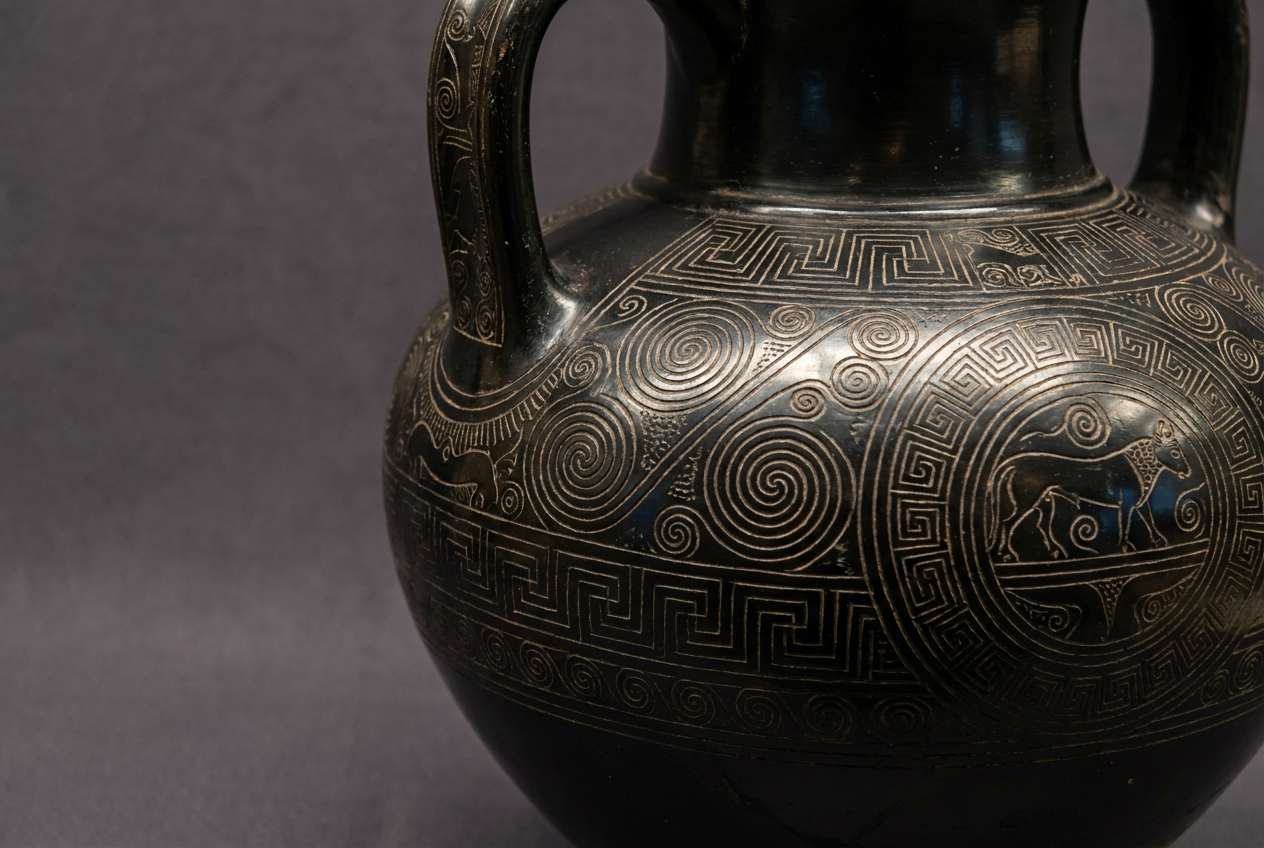
In addition to metals, they produced the famous Bucchero pottery , recognizable by its black color and metallic sheen, which imitated bronze vessels. This product was exported to almost all of Europe, from Gaul to Scandinavia, proving that Etruscan influence extended far beyond the borders of central Italy.
Religion and the Art of the Invisible
For the Etruscans, religion was not merely faith; it was a science. The Etruscan Discipline was a collection of sacred books that taught how to interpret the will of the gods through signs in nature. They were masters of haruspicy (reading the entrails of animals, especially the liver) and ceraunomancy (the study of lightning). The priests, known as haruspices, were figures of immense power and prestige.
The pantheon was polytheistic and heavily influenced by the Greeks, with deities such as Tinia (Zeus) and Uni (Hera). However, the Etruscan view of death was unique. They believed that life continued in the afterlife, and therefore built monumental necropolises that imitated the cities of the living. The tombs were decorated with frescoes depicting banquets, dances, and hunting scenes, transforming the sepulcher into a place of celebration and not just mourning.
Architecture and Artistic Legacy
In construction, the Etruscans were innovative. They introduced the semicircular arch , the barrel vault, and the dome, elements that would later be perfected and widely used by the Romans in their aqueducts and bridges. Their temples, although inspired by the Greeks, were different: they had higher bases (podia) and were made predominantly of wood and terracotta, with exuberant decorations on the roof.
In sculpture, they stood out for their naturalism, mastering three-dimensional art and its characteristics . While the Greeks idealized the human figure, the Etruscans preferred to represent faces realistically . Works such as the Chimera of Arezzo and the Sarcophagus of the Spouses demonstrate exceptional technical skill in working with bronze and terracotta, capturing human essence and mythology with precision.
The Rise of Rome and the Decline of Etruscans
The fall of the Etruscan civilization did not happen overnight, but was a slow process of erosion. In the 5th century BC, they began to lose strength due to invasions by Celtic peoples from the north and commercial competition from Syracuse. The lack of political unity among the city-states was the fatal blow, facilitating the gradual conquest by the Roman Republic.
Interestingly, Rome began as a cluster of villages under Etruscan influence. The first kings of Rome were of Etruscan origin, and the city inherited from them its first city walls, its drainage system, and even symbols of power such as the fasces and the curule chair. The Roman toga, the ultimate symbol of citizenship, is actually an adaptation of the Etruscan tunic. Thus, although they were militarily subjugated, the Etruscans triumphed culturally , shaping the foundation of what would become Roman civilization.
The Enigma of Language
One of the greatest mysteries that still challenges linguists is the Etruscan language. It does not belong to the Indo-European family, which makes it a linguistic isolate in the region. Although they used a variant of the Etruscan alphabet in their origin , which makes reading possible, understanding the meaning is extremely difficult. Most of the texts that have survived are short epitaphs or votive formulas.
There are some valuable exceptions, such as the Liber Linteus (Linen Book), the longest known text, which paradoxically survived because it was used to wrap a mummy in Egypt. The language gradually disappeared as Latin took over, but it left traces in the Roman vocabulary, with words like atrium and fenestra , which we still use in several modern languages.
The history of the Etruscans reveals a society that knew how to balance mystical faith with commercial pragmatism, creating a world where funerary art was a mirror of the joy of life and where women possessed an enviable status for Antiquity. From their mastery of bronze casting to the invention of architectural solutions that would sustain the Roman Empire, this people ceased to be merely a shadow of the past and became the key to understanding the formation of Western culture, proving that, even when a language falls silent, the stones and colors of the tombs continue to tell the story of a people who refused to be forgotten.