- The Cantabrian labarum is an identity symbol based on pre-Roman discoid stelae with tetrasquel motifs.
- There is a historical debate about its origin, oscillating between modern romantic reconstruction and the legacy of the old military standard 'cantabrum'.
- Its current visual representation consists of a golden tetraskelion on a purple or garnet background.
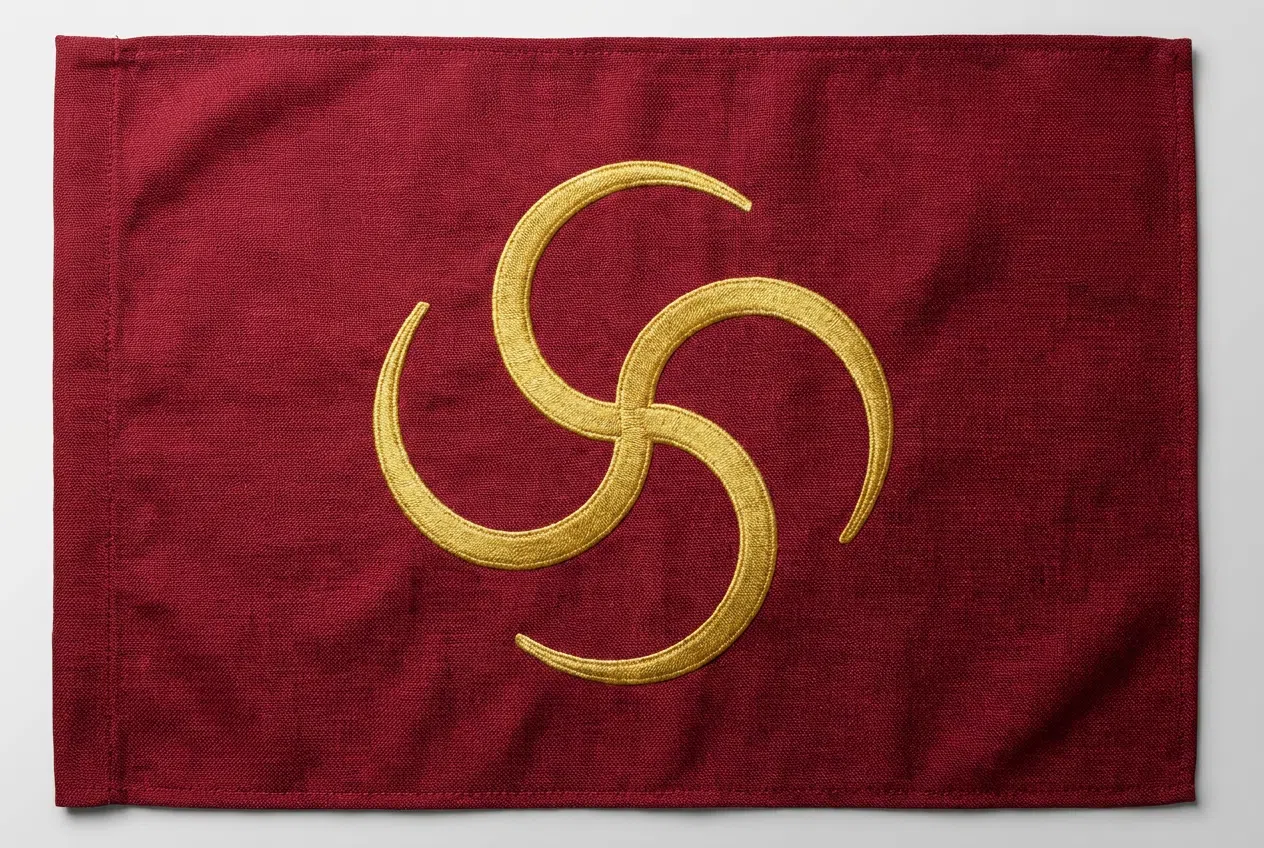
If you take a stroll through the streets of Cantabria, Spain, you'll notice a design that appears everywhere: from tattoos and stickers to flags on restaurants and cars. We're talking about the Cantabrian flag , an emblem that sparks the curiosity of any traveler and carries with it a visceral sense of pride for those born in this region.
But what exactly is this figure that looks like a golden whirlwind? To understand the story, we need to delve into the distant past, going back to the pre-Roman period, where the Cantabrian people, known for being warlike and resilient , lived in humid forests and fought fiercely to defend their territory against the ambitions of Rome.
The Archaeological Origin: The Stone Stelae

The visual basis of the labarum did not arise from nothing; it comes from fascinating archaeological pieces called discoid stelae . These gigantic stones, like the famous Barros Stelae, are monolithic discs related to solar and lunar cults. Some of these pieces, dating from the 4th century BC, have a tetraskelion in the center , which is basically a swastika cross with curved arms, a common ornamental motif in Celtic and Germanic cultures of northern Europe.
An impressive example is the Lombera Stelae , which can be seen at the Museum of Prehistory and Archaeology of Cantabria. The Barros Stelae, located in Corrales de Buelnas, are true stone colossi. Unfortunately, some of these relics suffer from a lack of proper conservation , facing infiltrations that can cause irreversible fungal damage, which deeply worries the local population.
The Debate: Military Symbol or Romantic Reconstruction?
Here things get controversial. Some argue that the labarum is a direct representation of the cantabrum , a military standard that the Cantabrians used to organize themselves in battles. The Romans, who were known for being extremely practical, would have adopted this signaling system after conquering the region in 19 BC, even creating the figure of the cantabrarii , soldiers responsible for carrying such standards.
On the other hand, many historians believe that the current flag is actually a romantic and modern reconstruction . They argue that there is no exact description of what the original looked like and that the contemporary version—with the golden tetrasquel on a purple or garnet background—serves more as a symbol of regional identity than as a proven historical fact. This discussion generates heated debates between those who see the banner as a symbol of resistance and those who see it as a recent invention.
Labarus vs. the Official Flag
It is important not to confuse the lábaro with the official flag of Cantabria. The official enseña, recognized by the statute of autonomy, consists of two horizontal stripes, white and red , with the regional coat of arms in the center. This version has roots in the 18th century and was formalized in 1845, originating from provincial maritime flags.
- Cantabrian Banner: A popular, identity-defining, and folkloric symbol, used in sporting and cultural contexts.
- Official Flag: Institutional representation of the regional government, with the colors white and red.
Although it is not the official flag of the state, the Parliament of Cantabria recognized the lábaro in 2016 as a symbol of the people's identity . Therefore, it is common to see it displayed in various municipalities, such as Torrelavega, Camargo, or Noja, where the population is keen to showcase its ancestral heritage.
The Connection with the Roman Empire and Christianity
Interestingly, the term "labaro" also has another meaning in the Roman world. In the 4th century AD, Emperor Constantine replaced the pagan eagle with the chrismon (the Greek letters X and P), creating the Christian imperial labaro. Although the etymology may cause confusion, the Cantabrian labaro focuses on the aesthetics of the tetraskelion and the memory of the peoples of the northern Iberian Peninsula, differentiating itself from Constantine's religious standard.
Whether as a revival of ancient military tactics or as an artistic expression based on millennia-old stones, the labarum remains a central element of the local culture. It unites the archaeology of discoid stelae , the memory of wars against Rome, and the contemporary desire to keep alive the essence of a people who never completely surrendered.