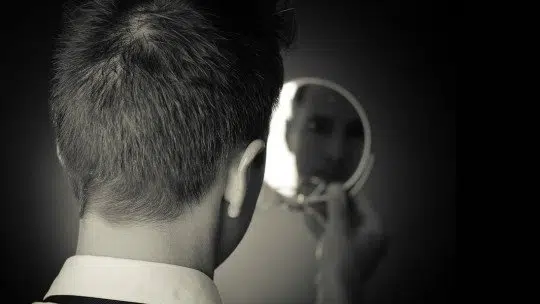
Catoptrophobia, also known as fear of mirrors, is an anxiety disorder characterized by an irrational and persistent fear of looking at one's own reflection in a mirror. This fear can arise from a variety of causes, such as past traumatic experiences, low self-esteem, superstitious beliefs, or even cultural influences.
Symptoms of catoptrophobia can vary from person to person, but typically include intense anxiety, sweating, rapid heartbeat, tremors, difficulty breathing, and avoidance of mirrors at all costs. Therapy is an effective approach to managing this fear, including gradual exposure techniques to the feared object, cognitive behavioral therapy, and muscle relaxation.
It's important to seek help from a mental health professional to deal with catoptrophobia, as it can significantly impact the quality of life and social relationships of those suffering from this disorder. With proper treatment, it's possible to overcome the fear of mirrors and live a calmer, more confident life.
Understand the meaning of Catoptrophobia, the fear of looking in the mirror.
Catoptrophobia is an irrational and persistent fear of looking in a mirror. People with this disorder avoid looking at their own reflection due to feelings of intense fear and anxiety.
The causes of catoptrophobia can vary from person to person, but are often related to past traumatic experiences, low self-esteem, bullying, or even cultural beliefs. Symptoms of this fear include sweating, rapid heartbeat, tremors, difficulty breathing, and even panic attacks.
Therapy is essential to help someone overcome catoptrophobia. Cognitive behavioral therapy, for example, can help the individual identify negative and distorted thoughts about their self-image and replace them with more positive and realistic ones.
It's important to seek professional help if you or someone you know suffers from a fear of mirrors. Catoptrophobia can be debilitating and significantly impact a person's quality of life. With proper treatment, it's possible to overcome this fear and live healthier, happier lives.
Why does the reflection in the mirror awaken so much fear and uncertainty in me?
Why does mirror reflections arouse so much fear and uncertainty in me? This is a question many people with catoptrophobia ask themselves constantly. Catoptrophobia is an irrational fear of mirrors and can cause a range of uncomfortable and disturbing symptoms.
The causes of this fear can vary from person to person, but are often related to past traumas, cultural beliefs, or even superstitions. The reflection in the mirror can be seen as a distorted representation of one's own image, leading to feelings of discomfort and fear.
Symptoms of catoptrophobia can include anxiety , tachycardia , cold sweats , and even panic . For some people, the simple act of looking in a mirror can trigger an intense anxiety attack.
Therapy is fundamental to the treatment of catoptrophobia. Through techniques such as cognitive-behavioral therapy and gradual exposure to fear , it is possible to overcome this irrational fear and learn to deal with reflections in the mirror in a more relaxed way.
So, if you also feel scared and insecure about your reflection in the mirror, know that you're not alone. Seek help from a qualified professional and take the first step toward overcoming this fear that plagues you so much.
Is it common to feel afraid when looking in the mirror?
For many people, looking in the mirror can be a frightening experience. Catoptrophobia, or fear of mirrors, is a specific phobia that can cause intense anxiety and discomfort when faced with one's own reflection. But why is it common to feel fear when looking in the mirror?
The causes of catoptrophobia can vary from person to person, but are generally related to past traumas, low self-esteem, distorted body image, and even cultural or religious beliefs. Common symptoms of this phobia include palpitations, sweating, tremors, difficulty breathing, and irrational thoughts that something bad will happen when looking in the mirror.
To overcome a fear of mirrors, it's important to seek professional help. Cognitive behavioral therapy, for example, can help individuals identify and modify negative and distorted thoughts about their reflection. Furthermore, gradual exposure to the feared object, in this case the mirror, can also be an effective strategy for overcoming the phobia.
If a fear of mirrors is significantly interfering with someone's quality of life, it's important to seek support from a mental health professional to address this issue in a healthy and effective way.
What is the name of the phobia of looking in the mirror?
The phobia of seeing oneself in a mirror is known as catoptrophobia . This condition is characterized by an intense and irrational fear of looking at oneself in a mirror. People who suffer from catoptrophobia may avoid mirrors at all costs, even avoiding passing near them.
The causes of catoptrophobia can vary from person to person, but are usually related to past traumatic experiences, low self-esteem, social anxiety, or body image issues. Symptoms of mirror phobia include extreme anxiety, sweating, tremors, rapid heartbeat, and irrational thoughts.
Treatment for catoptrophobia may involve cognitive behavioral therapy, gradual exposure to the feared object (in this case, the mirror), and relaxation techniques. It's important to seek help from a mental health professional to address this debilitating fear and improve your quality of life.
Fear of Mirrors (Catoptrophobia): Causes, Symptoms, and Therapy
There are many types of phobias that we talk about in Psychology and Mind , some very rare or strange, such as trypophobia. Phobias share many common symptoms and are quite frequent anxiety disorders.
All human beings can experience fear, an adaptive emotion that has allowed the human species to survive for centuries. Now, this adaptive emotion can become a situation that produces great discomfort and even irrational terror when faced with certain non-dangerous stimuli.
In fact, one of these phobias is catoptrophobia or eisoptrophobia . An irrational fear of something as commonplace as looking in a mirror.
The fear of mirrors, what is it about?
The fear of mirrors, or catoptrophobia, is a specific phobia belonging to the group of anxiety disorders , as its characteristic symptom is the discomfort and great anxiety suffered by people with the phobia. Within phobic disorders, there are three groups: social phobia, agoraphobia, or specific phobias. Regarding the latter, they appear in the presence of certain specific objects or situations, such as spiders (arachnophobia), flying in an airplane (aerophobia), or, in this case, in the presence of mirrors or looking at them.
Phobias cause the sufferer to avoid the feared situation or object and, for example, avoid going to places where they might encounter phobic stimuli, something that can disrupt their normal life. Perhaps in the case of fear of mirrors, this condition rarely negatively affects the person's life, except for the discomfort it causes, unlike other phobias, such as claustrophobia, where the sufferer is unable to take public transportation to work, hindering their work and social life.
Now, it may happen that these people avoid, for example, going to their friends' houses so as not to have to face their fear . Don't forget that mirrors are quite common objects and discomfort can occur at any time, unlike other phobias in which the person rarely comes into contact with the phobic stimulus, such as snakes.
Occasionally, catoptrophobia can be confused with spectrophobia, which is the fear of the existence or appearance of specters or spirits, because people with this phobic disorder may be afraid of seeing their own reflection in a mirror and think that the figure may emerge from the object.
What causes catoptrophobia?
Phobias can have different causes; however, most experts agree that irrational fears are learned . Until a few decades ago, the belief was that phobias were genetically inherited, but this view changed after investigations into classical conditioning, a type of associative learning that was originally discovered by a Russian physiologist named Ivan Pavlov.
This character tried to experiment with the dogs' saliva, which is why he brought them food. Well, dogs salivate when they're about to eat to facilitate the digestion process. Pavlov noticed that, at first, the dogs salivated in the presence of food, but that, after several attempts, the researcher's presence caused the dogs to salivate even without the food. This meant that the dogs associated Pavlov's presence with food, and thus the scientist elicited the response that food alone originally caused.
Fear learning in humans
Pavlov's experiments were the beginning of a new paradigm in Psychology: Behaviorism . But this school of thought did not become popular until John B. Watson popularized it in the United States and, consequently, in the world. Watson conducted experiments with a young child to induce a fear of certain stimuli, that is, to induce a phobia. This study is one of the most controversial in psychology and is called "Albert's little experiment".
In addition to this theory, another hypothesis based on the origin of phobias is that some stimuli are likely learned because we are biologically prepared to prevent the extinction of our species. Therefore, when we learn something, mechanisms are produced that have little to do with reason and logic, which is why it is difficult to overcome a phobia, even knowing that the fear is irrational.
On the other hand, this phobia can develop due to superstition or false beliefs, as there is a popular belief that breaking a mirror means that bad luck will follow us for seven years.
Symptoms of catoptrophobia
Symptoms of different types of phobias, whether specific or complex (social phobia and agoraphobia), are common. Anxiety is undoubtedly the most characteristic feature, accompanied by intense discomfort and an attempt to avoid mirrors. A person may experience the phobia when looking at mirrors or when confronted with their own reflection in mirrors.
In general, there are three types of catoptrophobia symptoms:
- Cognitive symptoms : experience of fear, great anxiety or anguish. Thoughts of escape.
- Behavioral symptoms : perform escape behaviors or avoid stimuli.
- physical symptoms : rapid pulse, tachycardia, headache, stomach ache, etc.
How to overcome this phobia
Fortunately, phobias are treatable, and psychological treatment works very well for these types of disorders . Since their origin is learned, Cognitive Behavioral Therapy has proven effective, and the prognosis for patient recovery is very good.
Within this type of therapy, methods such as relaxation techniques or exposure techniques are frequently used. One widely used type of exposure technique is systematic desensitization, which involves gradually exposing the patient to the phobic stimulus while learning more adaptive coping strategies. For example, it's possible to begin by showing the patient images of mirrors, and by the end of the therapy, the patient is able to pick up a mirror and look at it without fear.
However, this type of therapy, which works so well, belongs to the second-generation therapies, but the more recent third-generation has also been shown to be effective for any anxiety disorder. Among the latter are: Mindfulness-Based Cognitive Therapy and Acceptance and Commitment Therapy.
In extreme cases, drug treatment is also a therapeutic action to be considered, but it should always be combined with psychotherapy so that the symptoms persist over time.
Contents
- 1 Understand the meaning of Catoptrophobia, the fear of looking in the mirror.
- 2 Why does the reflection in the mirror awaken so much fear and uncertainty in me?
- 3 Is it common to feel afraid when looking in the mirror?
- 4 What is the name of the phobia of looking in the mirror?
- 5 Fear of Mirrors (Catoptrophobia): Causes, Symptoms, and Therapy
- 6 The fear of mirrors, what is it about?
- 7 What causes catoptrophobia?
- 8 Fear learning in humans
- 9 Symptoms of catoptrophobia
- 10 How to overcome this phobia