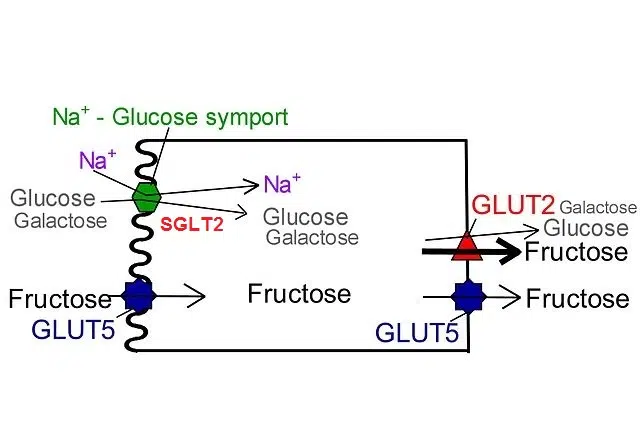
SGLT2, or sodium-glucose cotransporter, is a protein found in the proximal tubule cells of the kidneys that plays a key role in the reabsorption of glucose filtered by the glomeruli. This protein is responsible for transporting glucose from the urine back into the bloodstream, helping to maintain blood glucose levels within healthy limits. SGLT2 is also a target of medications used to treat type 2 diabetes, which work by inhibiting its activity and promoting the elimination of glucose in the urine.
Learn about the SGLT2 inhibitor drugs available on the pharmaceutical market.
SGLT2 (sodium-glucose cotransporter) is a protein responsible for glucose reabsorption in the kidneys. SGLT2 inhibitors work by blocking this protein, leading to the elimination of glucose in the urine, thus reducing blood sugar levels in patients with type 2 diabetes.
Currently, there are several SGLT2 inhibitor medications available on the pharmaceutical market, such as empagliflozin , canagliflozin, and dapagliflozin . These medications are prescribed to help control blood glucose levels in patients with type 2 diabetes and can be used alone or in combination with other hypoglycemic drugs.
In addition to lowering blood glucose levels, SGLT2 inhibitors also offer additional benefits, such as lowering blood pressure and body weight. However, it's important to note that these medications can be associated with side effects, such as urinary tract infections and diabetic ketoacidosis.
Therefore, it is essential that patients taking SGLT2 inhibitors undergo regular medical monitoring and follow their healthcare professional's recommendations. Always consult a doctor before starting any treatment with SGLT2 inhibitor medications.
Understanding SGLT2 inhibitors: mechanism of action and clinical indications.
SGLT2 inhibitors are a class of medications used to treat type 2 diabetes. They work by inhibiting the sodium-glucose cotransporter in the kidneys, which leads to the excretion of glucose in the urine and a consequent reduction in blood sugar levels. These medications also promote weight loss and lower blood pressure.
Clinical indications for SGLT2 inhibitors include blood glucose control in patients with type 2 diabetes, especially those who have not achieved control goals with diet and exercise alone. Additionally, these medications are also recommended for patients with cardiovascular disease, as they have been shown to reduce the risk of cardiovascular events.
It's important to note that SGLT2 inhibitors can cause side effects, such as urinary tract infections and diabetic ketoacidosis. Therefore, it's crucial that these medications are prescribed and monitored by a qualified healthcare professional.
Discover the main sglt1 inhibitors currently available on the pharmaceutical market.
SGLT2, or sodium-glucose cotransporter, is a protein found in the kidneys that plays an important role in the reabsorption of glucose filtered into the urine. SGLT2 inhibitors are a class of medications used to treat type 2 diabetes, as they help reduce blood glucose levels by promoting the elimination of glucose in the urine.
However, it's important to note that there are also SGLT1 inhibitors, which act differently. SGLT1 inhibitors are designed to reduce glucose absorption in the small intestine, which can also contribute to blood glucose control.
Some of the main SGLT1 inhibitors currently available on the pharmaceutical market include Dapagliflozin and Empagliflozin . These medications have proven effective in controlling glucose and treating type 2 diabetes, helping patients maintain healthy blood sugar levels.
It's important to emphasize that, although SGLT1 and SGLT2 inhibitors have different mechanisms of action, both play an important role in treating diabetes and improving patients' quality of life. It's essential to speak with a healthcare professional to determine the best treatment for each specific case.
Understand how dapagliflozin works in the body to control blood glucose.
Dapagliflozin is a medication used to treat type 2 diabetes. It works by inhibiting SGLT2, a sodium-glucose cotransporter in the kidneys.
Normally, SGLT2 is responsible for reabsorbing glucose filtered by the kidneys back into the bloodstream. However, by inhibiting the action of SGLT2, dapagliflozin prevents this reabsorption and causes glucose to be eliminated in the urine, thus reducing the amount of glucose in the blood.
By promoting the elimination of glucose through urine, dapagliflozin helps control blood glucose and reduce blood sugar levels. Additionally, this medication can also lead to weight loss, as glucose is an energy source that is eliminated rather than stored in the body.
Therefore, dapagliflozin effectively controls type 2 diabetes, helping to reduce blood sugar levels and promote weight loss. It's important to emphasize that its use should always be guided by a healthcare professional and combined with healthy eating and physical activity habits.
SGLT2 (sodium glucose cotransporter)
SGLT2 proteins belong to the SGLT/glucose sodium transporter family. Therefore, they perform the active transport of glucose molecules against a concentration gradient. This transport is possible because energy is obtained from sodium cotransport (symport).
In SGLT2, as in all isoforms belonging to the SGLT family, a conformational change is induced in the protein. This is essential for translocating the sugar to the other side of the membrane. This is made possible by the current generated by sodium, in addition to providing the energy necessary for transport.
This transporter, unlike SGLT1 (sodium and glucose transport proteins), only has the ability to transport glucose. However, the transport kinetics are quite similar in both.
SGLT2 is expressed primarily in the cells of the proximal convoluted tubule of the renal nephron and its function is to reabsorb glucose found in the glomerular filtrate that produces urine.
Glucose transport at the cellular level
Glucose is the main sugar through which most cells obtain energy to carry out various metabolic processes.
Because it's a sizable and highly polar monosaccharide, it can't cross the cell membrane on its own. This is why moving to the cytosol requires membrane components called transport proteins.
The glucose transporters that have been studied and characterized to date transport this metabolite through various transport mechanisms.
These transport proteins belong to two families: GLUTs (glucose transporters) and SGLTs (sodium/glucose cotransporters). GLUTs are involved in glucose transport by facilitated diffusion, while SGLTs carry out monosaccharide transport by active transport.
SGLT2 Structure
According to analyses of the primary structure of proteins using complementary DNA (cDNA) libraries, transporters from both families have a similar structure.
That is, 12 transmembrane domains in the case of GLUTs and 14 transmembrane domains in SGLTs. Likewise, all have a glycosylation site in one of the loops facing the extracellular side.
SGLT2 is an integral protein encoded by the SLC5A2 gene and has 672 amino acids with a 14-α-helix structure. Therefore, its secondary structure is quite similar to that of other members of the SGLT family.
Of the 14 α helices that make up the three-dimensional structure of the transporter, five of them are spatially arranged in the center of the same, with one of the lateral faces of each helix enriched in hydrophobic domains arranged towards the external side in contact with the hydrophobic core of the membrane.
In contrast, the inner face rich in hydrophilic residues is disposed inward, forming a hydrophilic pore through which substrates pass.
SGLT2 Features
SGLT2 is a low-affinity, high-capacity transporter whose expression is limited to the proximal convoluted tubule of the kidney, being responsible for 90% of glucose reabsorption.
Glucose transport by SGLT2 is carried out by a symmetrical mechanism, meaning sodium and glucose are transported in the same direction across the membrane against a concentration gradient. The energy stored by the electrochemical gradient is used to move glucose against its gradient.
SGLT2 inhibition is associated with decreased glucose levels and weight and calorie loss resulting from the elimination of glucose in the urine.
SGLT2 Functions
The function of this transporter is the reabsorption of glucose, it also participates in the reabsorption of sodium and water at the kidney level.
However, the discovery of aquaporins 2 and 6 in the proximal tubule and collecting tubules indicates that a thorough investigation of the mechanisms involved in water and solute transport processes in the tubular epithelium of the kidney should be carried out.

Renal function and SGLT2
The kidney filters approximately 180 liters of fluid and 160 to 180 grams of glucose. This filtered glucose is reabsorbed in the proximal tubule, meaning this sugar is absent from the urine.
However, this process is restricted by the renal glucose threshold. It has been suggested that this transport threshold is what allows for the maintenance of a necessary glucose supply when available carbohydrate concentrations are low.
This mechanism is affected in diabetic patients due to functional alterations at the nephron level. In this condition, increased glucose concentrations saturate transporters, leading to glycosuria, especially early in the disease.
As a result, the kidney undergoes modifications or adaptations that lead to malfunction, including an increase in the ability to transport glucose.
The increased capacity to transport glucose produces an increase in reabsorption at the level of the renal tubule and the latter is related to the overexpression in the number and activity of SGLT2 transporters.
In parallel, increased glucose reabsorption is accompanied by increased NaCl reabsorption. Increased glucose reabsorption, a product of which the nephron is functioning under stress, produces an increase in size and an inflammatory state that leads to the development of diabetic nephropathy.
References
- Bakris GL, Fonseca V, Sharma K, Wright E. Renal sodium-glucose transport: role in diabetes mellitus and potential clinical implications. Kidney Int. 2009; 75: 1272-1277.
- DeFronzo RA, Hompesch M, Kasichayanula S, Liu X, Hong Y, Pfister M, et al. Characterization of renal glucose reabsorption in response to dapagliflozin in healthy subjects and subjects with type 2 diabetes. Diabetes Care 2013;36(10):3169-3176.
- Hediger MA, Rhoads DB. SGLT2 mediates glucose reabsorption in the kidney. Physiol Rev. 1994; 74: 993-1026.
- Rahmoune H, Thompson PW, Ward JM, Smith CD, Hong G, Brown J. Glucose transporters in human renal proximal tubular cells isolated from the urine of patients with non-insulin-dependent diabetes. Diabetes 2005; 54 (12): 3427-3434.
- Rieg T, Masuda T, Gerasimova M, Mayoux E, Platt K, Powell DR, et al. Increased SGLT1-mediated transport explains renal glucose reabsorption during genetic and pharmacological SGLT2 inhibition in euglycemia. Am J Physiol Renal Physiol. 2014;306(2):F188-193.
- Vallon V, Gerasimova M, Rose MA, Masuda T, Satriano J, Mayoux E, et al. The SGLT2 inhibitor empagliflozin reduces renal growth and albuminuria in proportion to hyperglycemia and prevents glomerular hyperfiltration in diabetic Akita mice. Am J Physiol Renal Physiol. 2014; 306(2): F194-204.
- Poços RG, Mohandas TK, Hediger MA. Localization of the Na+/glucose cotransporter gene SGLT2 on human chromosome 16 near the centromere. Genomics 1993; 17(3): 787-789.
- Wright, EM. Renal Na(+)–glucose cotransporter. Am J Physiol Renal Physiol. 2001; 280: F10-18.
- Wright EM, Hirayama BA, Loo DF. Active sugar transport in health and disease. J Intern Med. 2007; 261: 32-43.
Contents
- 1 Learn about the SGLT2 inhibitor drugs available on the pharmaceutical market.
- 2 Understanding SGLT2 inhibitors: mechanism of action and clinical indications.
- 3 Discover the main sglt1 inhibitors currently available on the pharmaceutical market.
- 4 Understand how dapagliflozin works in the body to control blood glucose.
- 5 SGLT2 (sodium glucose cotransporter)
- 6 Glucose transport at the cellular level
- 7 SGLT2 Structure
- 8 SGLT2 Features
- 9 SGLT2 Functions
- 10 References